
Keywords
Religion
Benjamin Franklin
American Political Thought
Wit
political comedy
Benjamin Franklin
American Political Thought
Wit
political comedy
How to Cite
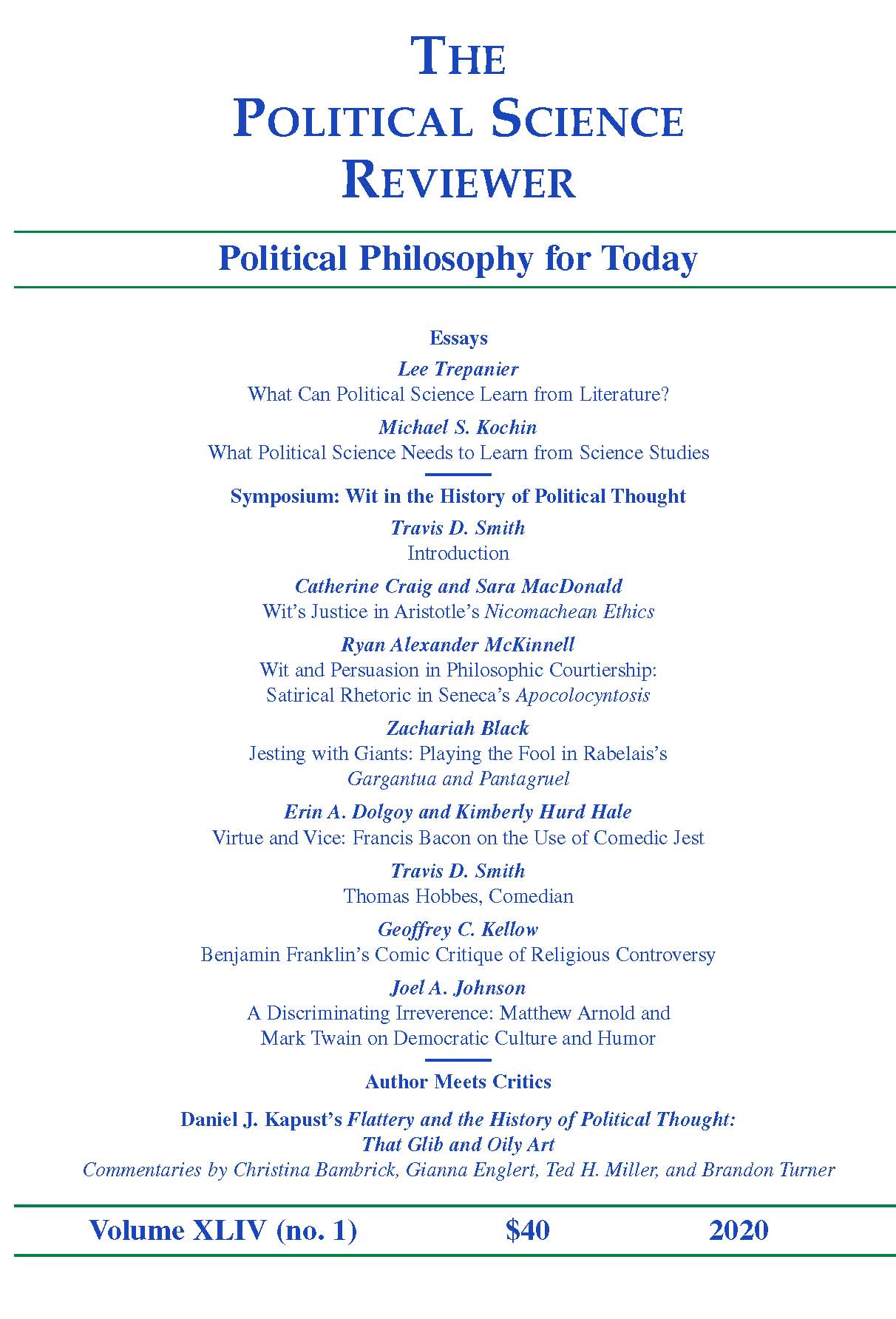
Benjamin Franklin’s Comic Critique of Religious Controversy. (2020). The Political Science Reviewer, 44(1), 175-198. https://www.politicalsciencereviewer.com/index.php/psr/article/view/631
Abstract
This paper explores Benjamin Franklin’s use of satire, parody and literary hoax to address the relationship between religion and politics. In using humour and an occasionally more caustic wit, Franklin meant to prompt in his readers an awareness of the character and substance of religion and religious controversy. Considering the latter, Franklin deployed comic anecdotes to draw a distinction between the essential and epiphenomenal elements of religious belief, an exercise predicated on the assumption of a deep concordance across denominations and faiths regarding the essence of religion. Franklin found in humour a means to bound religion, drawing out a salutary space and a common religious core for both citizens and society.